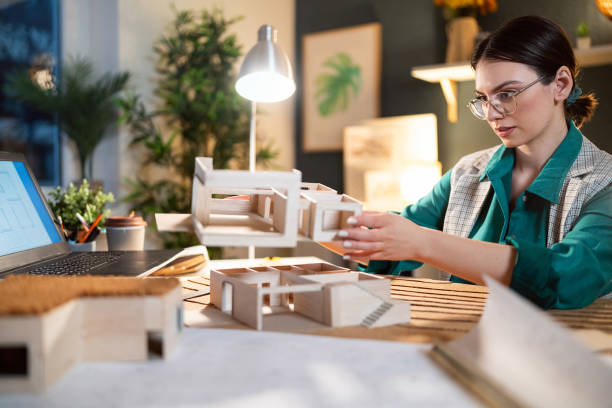
Real estate developers spend serious money on marketing — cinematic walkthrough videos, drone footage of the site, glossy brochures. Yet ask most sales teams which single tool actually closes the most deals in a face-to-face meeting, and a surprising number will point to the model sitting in the corner of the sales office. There’s something about an architectural scale model that makes an abstract floor plan suddenly feel real to a buyer, and that psychological effect is difficult to replicate with any screen-based medium.
Buyers Trust What They Can Physically Verify
When a buyer looks at a rendered video, they’re trusting the marketing team’s choices about camera angle, lighting and pacing. When they look at a physical model, they can walk around it, look at it from above, check how close the neighbouring tower is, and generally verify claims for themselves. That sense of independent verification builds trust in a way that a carefully edited video, however beautiful, simply cannot.
Models Answer Questions Before They’re Asked
A well-built model of a township or high-rise development answers a huge number of buyer questions instantly and visually: how far is the clubhouse from my building, does my unit face the garden or the parking area, how much open space is actually between towers. Sales teams that use models well report shorter, more confident conversations, because half the usual questions are answered just by the buyer studying the model themselves.
Scale and Proportion Are Hard to Fake Digitally
Renders can subtly exaggerate the sense of space through wide-angle lenses and dramatic lighting, whether intentionally or not. A physical model built to an accurate scale doesn’t have that luxury, everything is proportionate by definition. Buyers who have been burned before by projects that looked spacious in renders but felt cramped on-site have learned, often the hard way, to trust the model over the video.
What Makes a Sales-Ready Model Work
The best sales models go beyond just the buildings. They include contextual details — surrounding roads, nearby landmarks, greenery, water features — that help a buyer orient themselves and understand the project’s relationship to its surroundings. Lighting is often integrated to highlight key features after dark when sales offices tend to stay open into the evening. And crucially, the finish quality needs to hold up to daily handling, since these models often sit in high-traffic sales lounges for months or years.
A Long-Term Marketing Asset, Not a One-Time Expense
Unlike a video campaign that eventually goes stale, a well-maintained physical model can serve a sales office through the entire duration of a project launch, and sometimes gets repurposed for exhibitions, investor meetings or municipal presentations along the way. When you factor in that extended usable life, the cost per interaction ends up being remarkably low compared to most other marketing tools in a developer’s budget.
Getting the Placement and Presentation Right
Even a beautifully built architectural scale model loses impact if it’s placed poorly in the sales office, tucked in a corner, poorly lit, or positioned so buyers can’t walk around it freely. The best sales teams treat the model as the centrepiece of the space, positioned where a salesperson can naturally gesture toward specific units while talking, with lighting that highlights it clearly without washing out its finer details. A little thought given to placement and staging pays off directly in how much attention and trust the model earns during a walk-through.
It’s also worth briefing the sales team on how to actually use the model rather than just having it sit there as decoration. Salespeople who know how to point out a buyer’s specific unit, explain the surrounding amenities, and use the model to answer common objections tend to close conversations faster than those who leave it as background scenery.
When to Update or Replace a Sales Model
Large projects sometimes go through design changes even after sales have started, whether that’s an added amenity block, a revised tower height, or a change in unit configuration. Developers should plan for the possibility that a model will need updating partway through a launch, and it’s worth asking a studio upfront whether they offer this kind of amendment service rather than requiring an entirely new build for every change.
Measuring the Return on a Sales Model
Marketing teams are often asked to justify spending against measurable returns, and a physical model can be harder to attribute directly to a closed sale than a digital ad campaign with clear click-through data. Still, many sales teams track a simple proxy, average time spent at the model during a site visit, and correlate it informally with conversion rates. Visits where a buyer lingers at the model, asking questions and pointing things out, tend to close at noticeably higher rates than visits where the model is glanced at and ignored.
Some developers also track how often the model gets referenced in follow-up calls or emails after a site visit, using it as an anecdotal signal of how memorable the presentation was. While not a perfect metric, this kind of informal tracking often gives marketing teams enough confidence to keep the model budget in place for future project launches, rather than cutting it in favour of purely digital alternatives.
Pairing the Model With Digital Tools, Not Replacing Either
The most effective sales offices tend to use the model and digital tools together rather than treating them as competing options. A buyer might start with a video walkthrough on a tablet, move to the physical model to understand the layout and scale, and finish with a digital configurator to explore unit-specific options like floor level or view direction. Each medium plays to its own strength in that sequence, the video sets an emotional tone, the model builds spatial trust, and the configurator handles the specific, transactional details a physical model can’t practically show for every single unit.
Developers who design their sales journey around this kind of sequencing, rather than defaulting entirely to one medium, tend to see stronger engagement across the board, since buyers process information differently and benefit from encountering it in more than one format.
Conclusion
In an industry where trust is the biggest barrier to closing a sale, a well-built architectural scale model does something no video can: it lets the buyer verify the claims with their own eyes. That’s a powerful advantage, and it’s why serious developers continue investing in getting this piece of their sales strategy right.